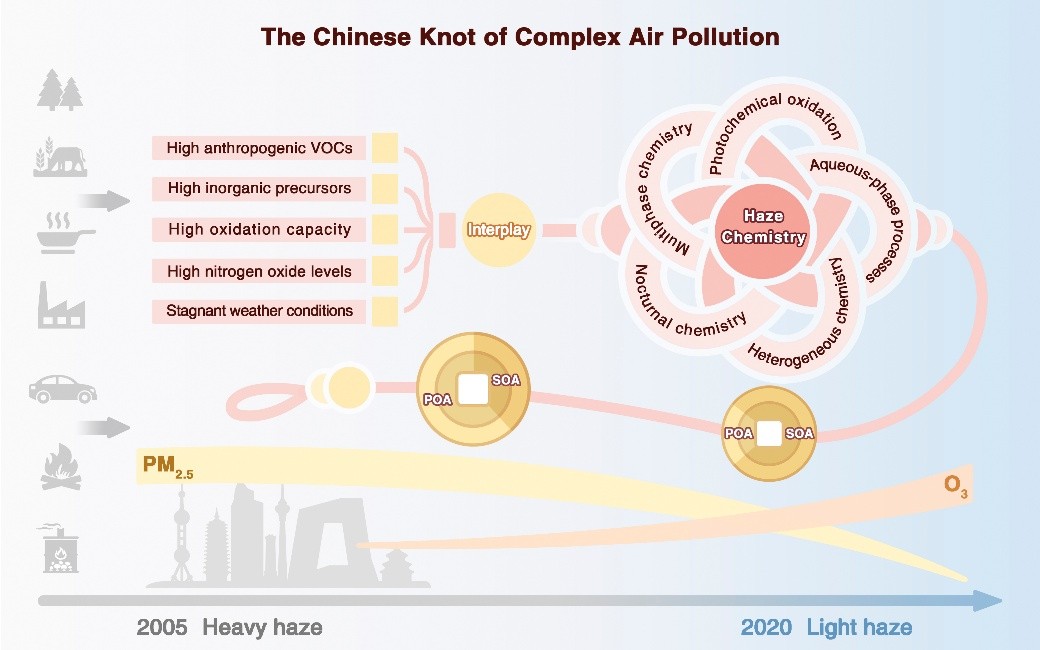

The paper “Secondary Organic Aerosol in Urban China: A Distinct Chemical Regime for Air Pollution Studies” was published in Science on August 28, 2025.
By Ru-Jin Huang, Yong Jie Li, Qi Chen, Yanli Zhang, Chunshui Lin, Chak K. Chan, Jian Zhen Yu, Joost de Gouw, Shengrui Tong, Jingkun Jiang, Weigang Wang, Xiang Ding, Xinming Wang, Maofa Ge, Weijian Zhou, Douglas R. Worsnop, Michael Boy, Merete Bilde, Ulrike Dusek, Annmarie G. Carlton, Thorsten Hoffmann, V. Faye McNeill, and Marianne Glasius.
Abstract: In the past decades, China has witnessed high air pollution associated with rapid economic development, although regulatory efforts have alleviated the situation since 2013. Haze events characterized by high particulate matter (PM) levels in China are not only of enormous magnitude but also represent a distinct chemical regime. Once driven by direct emissions, these high-PM episodes are now more affected by secondary aerosol, especially secondary organic aerosol (SOA). This Review synthesizes the state of the science of SOA formation in urban China, specifically (i) how the dominance of anthropogenic precursors affects SOA formation, (ii) what are the prevailing SOA formation mechanisms, and (iii) how important are the multipollutant and multiphase processes in SOA formation and evolution. We also highlight essential directions for future studies.
More information can be found at:
https://www.science.org/doi/10.1126/science.adq2840