
J. Duan, R. J. Huang*, C. S. Lin, J. Qu, J. H. Liu, W. Huang, Y. N. Zhan, W. Yuan, T. Wang, L. Y. Zhou, W. Xu, Q. Liu, Z. R. Liu, S. R. Lou, H. N. Yang, D. D. Huang, C. Huang, and H. L. Wang (2025), Relative Humidity Modulates Photochemical Aging of Light-Absorbing Carbonaceous Aerosols: Insights from Ambient Oxidation Flow Reactor, Environmental Science & Technology, 59(45), 24481-24491, doi:10.1021/acs.est.5c10614.
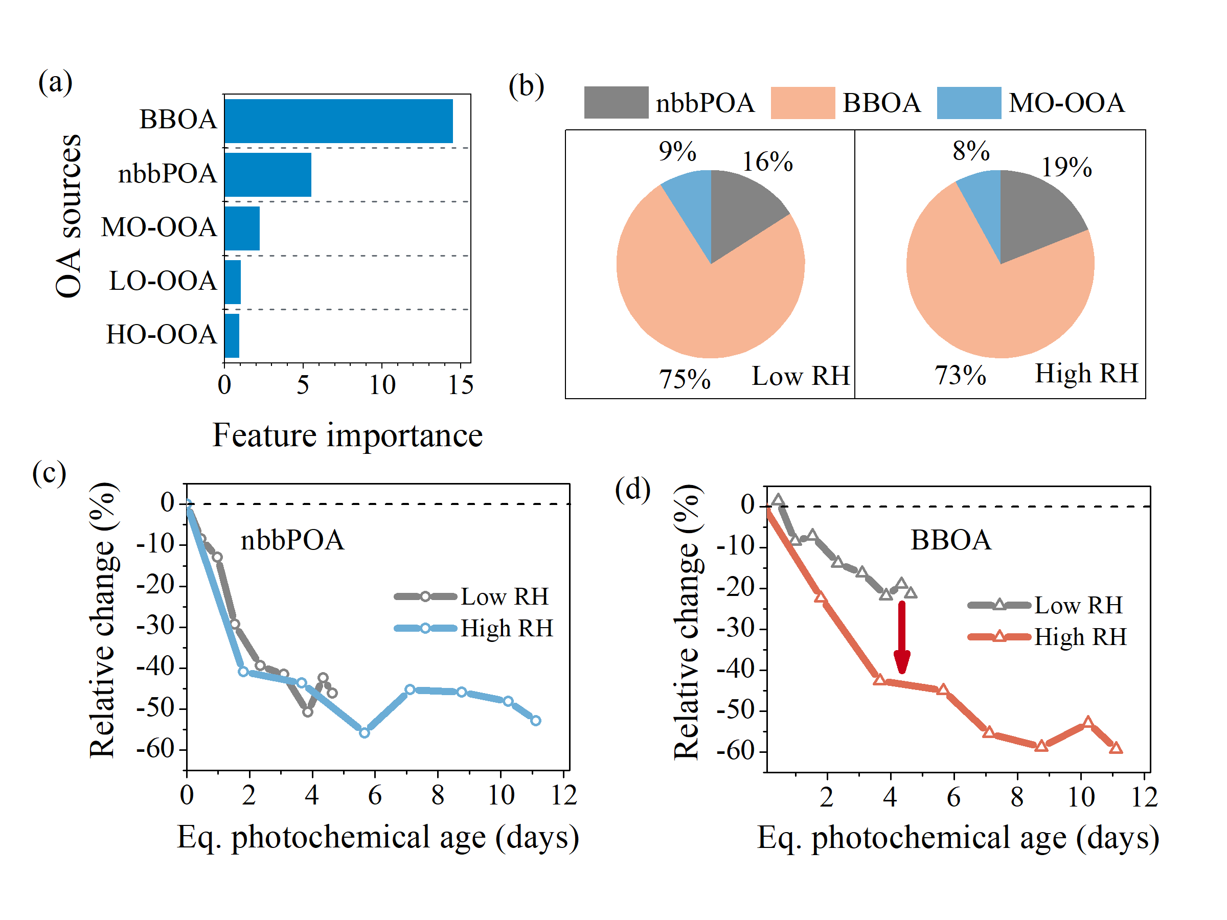
Light-absorbing carbonaceous aerosols (LACs), including black carbon (BC) and brown carbon (BrC), significantly influence Earth’s radiative balance and global climate. However, their atmospheric aging processes and associated optical evolution remain insufficiently understood. In this study, in situ photochemical aging of ambient LACs under varying relative humidity (RH) conditions was simulated using an oxidation flow reactor (OFR). The distinct absorption evolution of BC and BrC was investigated, and the underlying mechanisms were explored. BC absorption primarily decreased under low-RH aging but significantly increased under high-RH aging. This contrasting behavior can be attributed to RH-dependent changes in BC coating processes: the dominant loss of preexisting coatings at low RH versus enhanced formation of secondary species that preferentially coat BC under high RH. Notably, BC absorption enhancement is more sensitive to nitrate, ammonium, and secondary organic aerosol (SOA) formation than to sulfate. BrC exhibited optical bleaching under both RH conditions; however, the bleaching rate was substantially accelerated under high RH at comparable photochemical ages within the range of below 5 equiv atmospheric aging days. This is primarily due to a 2-fold increase in the aqueous-phase photooxidative degradation of BrC chromophores derived from biomass-burning sources, whereas nonbiomass BrC showed RHindependent bleaching. These findings show that RH strongly modulates the chemical and optical aging of LACs, with important implications for their direct radiative forcing and better representation in climate models.