
W. Yuan, J. Duan, T. Wang, H. T. Cui, Y. Liu, J. Guo, W. J. Cao, M. Jing, L. Y. Zhou, W. Xu, and R. J. Huang* (2025), High Abundance of Intermediate Volatile Organic Compounds in Water-Soluble Humic-Like Substances in Oxidizing Urban Air, Environmental Science & Technology Letters, 12(10), 1394-1401, doi:10.1021/acs.estlett.5c00833.
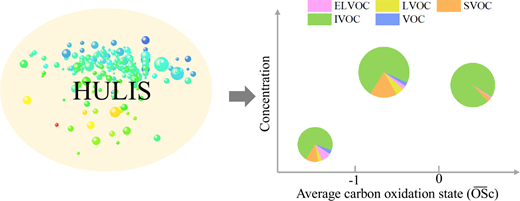
Water-soluble humic-like substances (HULIS) are ubiquitous in the atmosphere affecting air quality and Earth's radiative balance. However, the molecular composition of ambient HULIS remains poorly constrained. This study employed gas chromatography-orbitrap mass spectrometry to conduct nontargeted molecular characterization of HULIS in ambient PM2.5 samples. A total of 60-193 organic compounds were identified in HULIS across seasons, and both their quantities (66.7-78.0%) and mass concentrations (75.5-84.6%) were dominated by intermediate-volatility organic compounds (IVOCs). The mass concentrations of IVOCs in both highly oxidized (average carbon oxidation state, OS̄c > 0) and less oxidized (-1 < OS̄c ≤ 0) HULIS fractions were approximately four times that in the reduced HULIS fraction (OS̄c ≤ −1), indicating that the atmospheric oxidation process enhances the dominance of IVOCs in HULIS. Organic acids were the most prevalent substances in IVOCs, accounting for 63.5-78.3% of total IVOC mass concentration in different seasons. Besides, in summer, amines and alcohols also contributed 15.3-17.5% to total IVOC mass concentration, while in winter, N-heterocycles and phenols contributed 16.9-17.5%. This study advances the understanding of the molecular composition of ambient HULIS and highlights the dominance of IVOCs, which enhances the understanding of the atmospheric evolution processes and formation mechanisms of ambient HULIS.