
Y. F. Gu, R. J. Huang*, J. Duan, W. Xu, C. S. Lin, H. B. Zhong, Y. Wang, H. Y. Ni, Q. Liu, R. G. Xu, L. T. Wang, and Y. J. Li (2023), Multiple pathways for the formation of secondary organic aerosol in the North China Plain in summer, Atmospheric Chemistry and Physics, 23(9), 5419-5433, doi:10.5194/acp-23-5419-2023.
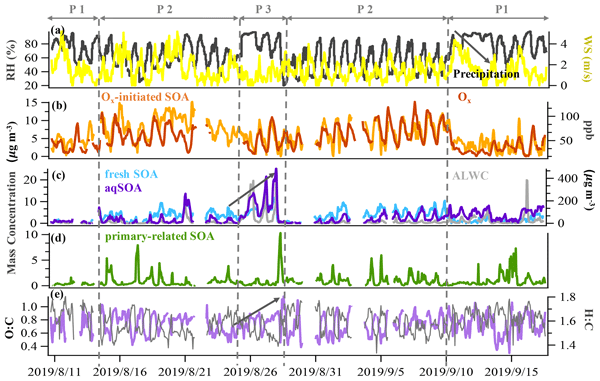
Secondary organic aerosol (SOA) has been identified as a major contributor to fine particulate matter (PM2.5) in the North China Plain (NCP). However, the chemical mechanisms involved are still unclear due to incomplete understanding of its multiple formation processes. Here we report field observations in summer in Handan of the NCP, based on high-resolution online measurements. Our results reveal the formation of SOA via photochemistry and two types of aqueous-phase chemistry, the latter of which include nocturnal and daytime processing. The photochemical pathway is the most important under high-Ox (i.e., O3 + NO2) conditions (65.1 ± 20.4 ppb). The efficient SOA formation from photochemistry (Ox-initiated SOA) dominated the daytime (65 % to OA), with an average growth rate of 0.8 µg m-3 h-1. During the high-relative-humidity (RH; 83.7 ± 12.5 %) period, strong nocturnal aqueous-phase SOA formation (aqSOA) played a significant role in SOA production (45 % to OA), with a nighttime growth rate of 0.6 µg m-3 h-1. Meanwhile, an equally fast growth rate of 0.6 µg m-3 h-1 of Ox-initiated SOA from daytime aqueous-phase photochemistry was also observed, which contributed 39 % to OA, showing that photochemistry in the aqueous phase is also a non-negligible pathway in summer. The primary-related SOA (SOA attributed to primary particulate organics) and aqSOA are related to residential coal combustion activities, supported by distinct fragments from polycyclic aromatic hydrocarbons (PAHs). Moreover, the conversion and rapid oxidation of primary-related SOA to aqSOA were possible in the aqueous phase under high-RH conditions. This work sheds light on the multiple formation pathways of SOA in ambient air of complex pollution and improves our understanding of ambient SOA formation and aging in summer with high oxidation capacity.