
T. Wang, J. Duan, L. Y. Zhou, L. Yang, J. C. Shen, W. Yuan, J. Guo, W. Xu, and R. J. Huang* (2026), Molecular-Level Chromophoric Profiles of Brown Carbon from Residential Biomass Burning and Coal Combustion, Environmental Science & Technology Letters, 13(3), 373-379, doi:10.1021/acs.estlett.5c01222.
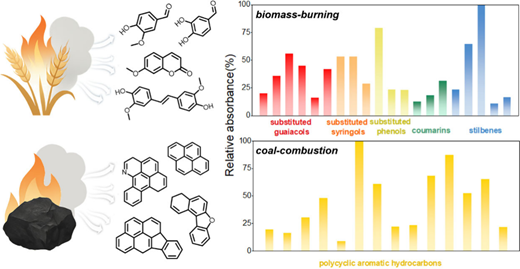
Residential solid fuel combustion is a major source of atmospheric brown carbon (BrC), yet the emission characteristics remain poorly constrained, leading to substantial uncertainties in estimating climatic impacts. In this study, the liquid chromatography–photodiode array–high-resolution mass spectrometry (HPLC–PDA–HRMS) method was applied to resolve the molecular fingerprints of BrC emitted from biomass burning and coal combustion. The mass absorption efficiency (MAE) of biomass-derived BrC was consistently higher than that of coal-derived BrC over the range of 300–500 nm, reflecting distinct source-dependent chromophoric compositions. A total of 29 chromophores (3.3–4.2 g kg–1) identified in biomass burning explained 35.4–50.3% of the total BrC light absorption, while 20 chromophores (0.4 g kg–1) from coal combustion accounted for 37.0%. Biomass-derived BrC was dominated by lignin pyrolysis products, stilbenes, coumarins, and flavonoids, while coal-derived BrC contained more polycyclic aromatic hydrocarbons and N/O-containing aromatics. Nitrophenols, such as methoxy nitrocatechol and 4-nitro-3-vinylsyringol, were detected in flaming emissions but absent in smoldering, serving as distinct molecular tracers for combustion conditions of biomass burning. These results establish source-resolved chromophoric profiles and reveal distinct optical contributions of biomass- and coal-derived BrC, providing molecular-level insights to improve atmospheric BrC source apportionment and radiative forcing assessment.