
Y. Zhou, W. H. Zhang, J. L. Lang, X. D. Li, X. H. Zheng, C. X. Yang, R. J. Huang*, D. S. Chen, and S. Y. Cheng (2026), Spatiotemporal Dynamics and Key Drivers of Brown Carbon Emissions from Biomass Burning in China: A Historical to Future Perspective (1980–2035), Environmental Science & Technology, 60(8), 6177-6187, doi:10.1021/acs.est.5c15482.
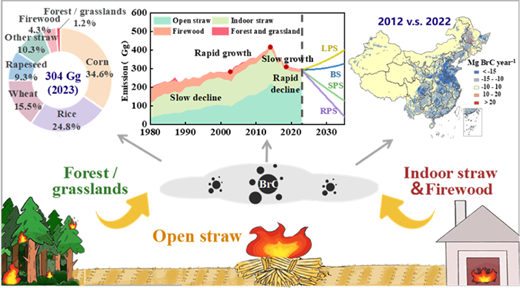
Brown carbon (BrC) affects climate and the environment. Biomass burning (BB) is a major BrC emission source, yet insufficient understanding of long-term emission trends from different sources and their underlying drivers hinders the accurate assessment of regional climate and environmental effects, as well as the development of targeted mitigation strategies. We integrated provincial socioeconomic data, remote sensing data, and source-specific emission factors to quantify the magnitude, spatial variations, and trends (1980–2023) of BrC emissions from BB in China. Furthermore, we analyzed the period-specific drivers and projected future emissions under different policy scenarios. The BrC emissions rose and then fell (1980–2023), peaking in 2014 at 433 (95% CI: 323–635) Gg, with an increasing contribution from open emissions. The major emission regions migrated from areas with intensive indoor biomass use (e.g., South-Central China) to those with main crop-producing regions (e.g., Northeast China). Agricultural expansion, energy structure changes, and policy controls are the primary factors driving emission variations, while the main drivers of indoor and open emissions varied across different periods. Projections of the baseline scenario indicate that open emissions should be paid more attention, given their continued contribution (94%, 2035). Maintaining existing control efforts may lead to a slight increase in emissions (11%) due to growing straw output and control uncertainties. More rigorous control of straw-burning policies and differentiated management strategies could decrease emissions.