
J. Duan, L. Y. Zhou, R. J. Huang*, Y. N. Zhan, J. Qu, J. H. Liu, C. S. Lin, T. Wang, H. Zhong, J. Y. Ren, W. Huang, W. Xu, Q. Liu, Z. R. Liu, S. R. Lou, H. Yang, D. D. Huang, C. Huang, and H. L. Wang (2026), Enhanced Secondary Organic Aerosol Formation in Humid Urban Air: The Evolution of Oxygenated Volatile Intermediates, Environmental Science & Technology, 60(26), 18756-18766, doi:10.1021/acs.est.5c18969.
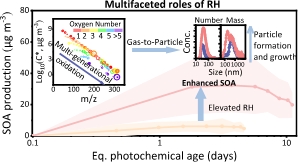
Secondary organic aerosol (SOA) formation is strongly influenced by relative humidity (RH), yet the underlying processes remain insufficiently understood under realistic atmospheric conditions. This study investigates RH-dependent SOA formation from ambient urban air using a field-deployable oxidation flow reactor (OFR), focusing on the multigenerational oxidation of volatile organic compound (VOC) precursors and their gas-to-particle transformation. Elevated RH markedly enhanced SOA production, yielding nearly 5-fold higher OA mass growth compared to low-RH oxidation under comparable photochemical ages. Evolution patterns of oxygenated VOCs (OVOCs) reveal that high RH accelerates the oxidative transformation of less-oxidized, higher-volatility intermediates into more-oxidized, lower-volatility products. These generational products facilitate SOA formation via condensation onto pre-existing particles and through formation and growth of new particles. This is corroborated by the more pronounced increase in particle number concentrations at 20–200 nm during high-RH oxidation, alongside substantial OA mass growth in both newly formed particles (100–200 nm) and pre-existing particles (∼500 nm). Potential water photolysis and thus OH production within the particle phase under high RH may also contribute to the oxidation processes. Overall, this work highlights the multifaceted role of RH in urban SOA formation, reflecting its concurrent influences on OVOC transformation, particle formation and growth, and gas-particle partitioning of oxidized products. These insights refine our understanding of SOA formation mechanisms under realistic atmospheric conditions.