
Ren, J., Zhang, F*., Chen, L., Liu, J., Xu, W., Xu, H., Wang, Z., Huang, R.-J*. (2026). Characterization of hygroscopicity-based mixing state at four sites in China. Journal of Aerosol Science, 198, 106868.
https://doi.org/10.1016/j.jaerosci.2026.106868.
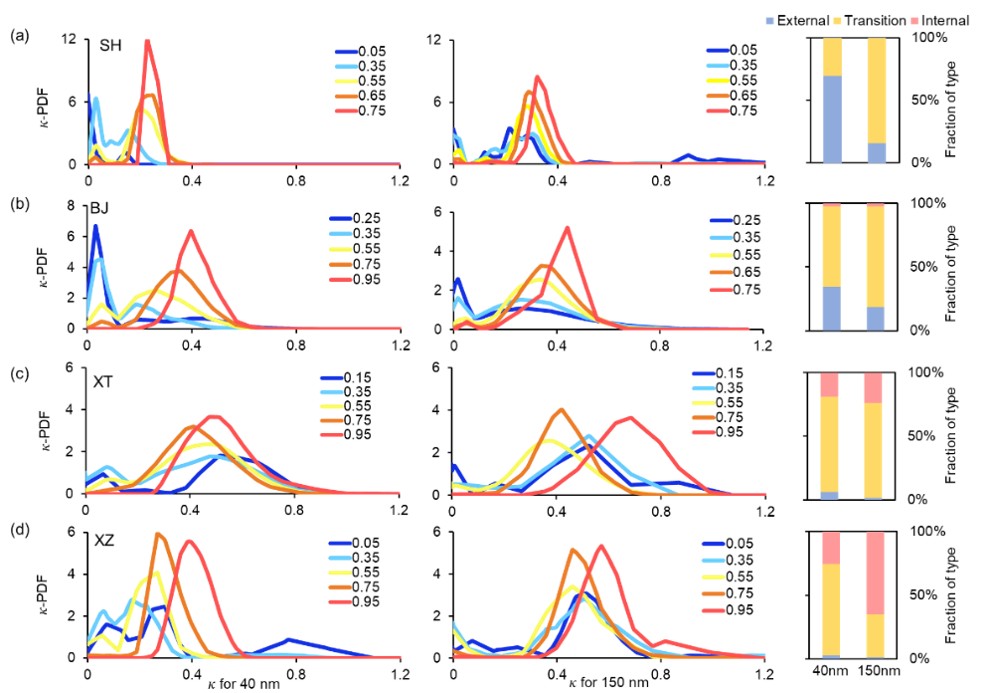
Aerosol mixing state is a critical parameter regulating hygroscopicity and its climate effects, yet its evolution across different environments remains poorly understood. This study investigates the mixing state index (χ) evolution from hygroscopicity measurements at four sites. The results show that urban sites are dominated by externally mixed/transitional states, while industrial and regional-background sites exhibit higher internal mixing. The hygroscopic distribution transitions from multimodal to unimodal with increasing χ, establishing χ as a robust tracer for aerosol aging. The shift of change rate of χ from negative to positive has a critical threshold of 0.6. When χ exceeds 0.6, hygroscopicity enhancement (κgf/κchem) increases, particularly at sites with rapid aging. This coating-induced enhancement is further supported by diurnal cycles showing peak κgf/κchem ratios coinciding with the increment of χ during noontime photochemical aging. This finding demonstrates that the mixing state index χ provides a framework for quantifying aerosol aging and its impact on hygroscopicity, with implications for improving aerosol process in climate models.