
Y. Liu, R. J. Huang*, C. S. Lin, W. Yuan, Y. J. Li, H. B. Zhong, L. Yang, T. Wang, W. Huang, W. Xu, D. D. Huang, and C. Huang (2024), Nitrate-Photolysis Shortens the Lifetimes of Brown Carbon Tracers from Biomass Burning, Environmental Science & Technology, 59(1), 640-649, doi:10.1021/acs.est.4c06123.
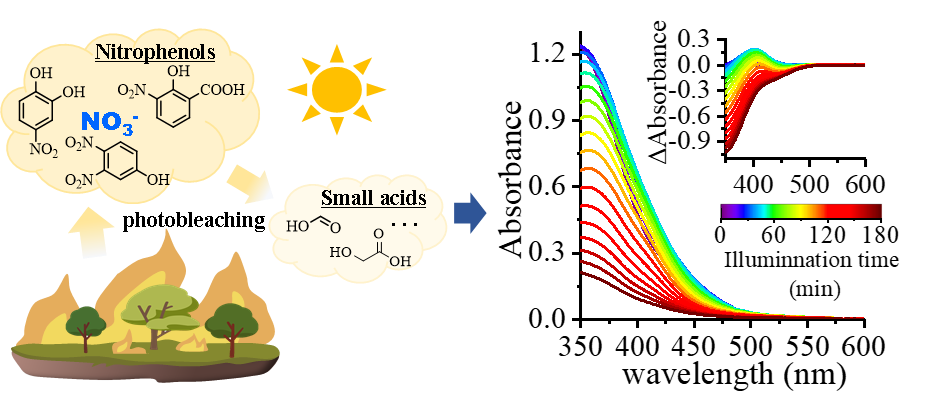
Biomass burning is an important source of brown carbon (BrC) aerosols, which influence climate by affecting the Earth’s radiative balance. However, the transformation pathways of BrC chromophores, especially in the presence of photochemically active species, such as nitrate, are not well understood. In this study, the nitrate-mediated aqueous-phase photooxidation of three typical BrC chromophores from biomass burning was investigated, including 4-nitrocatechol, 3-nitrosalicylic acid, and 3,4-dinitrophenol. Variations in nitrate concentrations, pH, and temperatures were systematically examined to assess their impacts on the apparent photolysis rates of these BrC chromophores. The results show that increasing nitrate concentrations significantly enhances apparent photolysis rates to 3−3.5 times compared to nitrate-free conditions. Also, a temperature rise from 0 to 30 °C increases apparent photolysis rates by a factor of 1.3−2.5 for these chromophores. However, the effect of pH varies among these chromophores, depending on the substituents and their positions on the benzene ring. High-resolution mass spectrometric analysis suggests that the photooxidation of these chromophores initiates with the addition of nitro and/or hydroxyl groups to the benzene ring, followed by a ring-opening reaction and the formation of smaller, highly oxygenated molecules including formic acid, glyoxylic acid, malonic acid, and nitropropanoic acid. This study highlights the key role of nitrate in the aqueous-phase photooxidation of BrC, altering the aging pathways and shortening the atmospheric lifetimes of BrC. These results are of particular importance for a better understanding of BrC aging and its radiative forcing, given the increase of the nitrate mass fraction in aerosols of China in recent years.