Ru-Jin Huang et al. ,Secondary organic aerosol in urban China: A distinct chemical regime for air pollution studies.Science389,eadq2840(2025).DOI:10.1126/science.adq2840
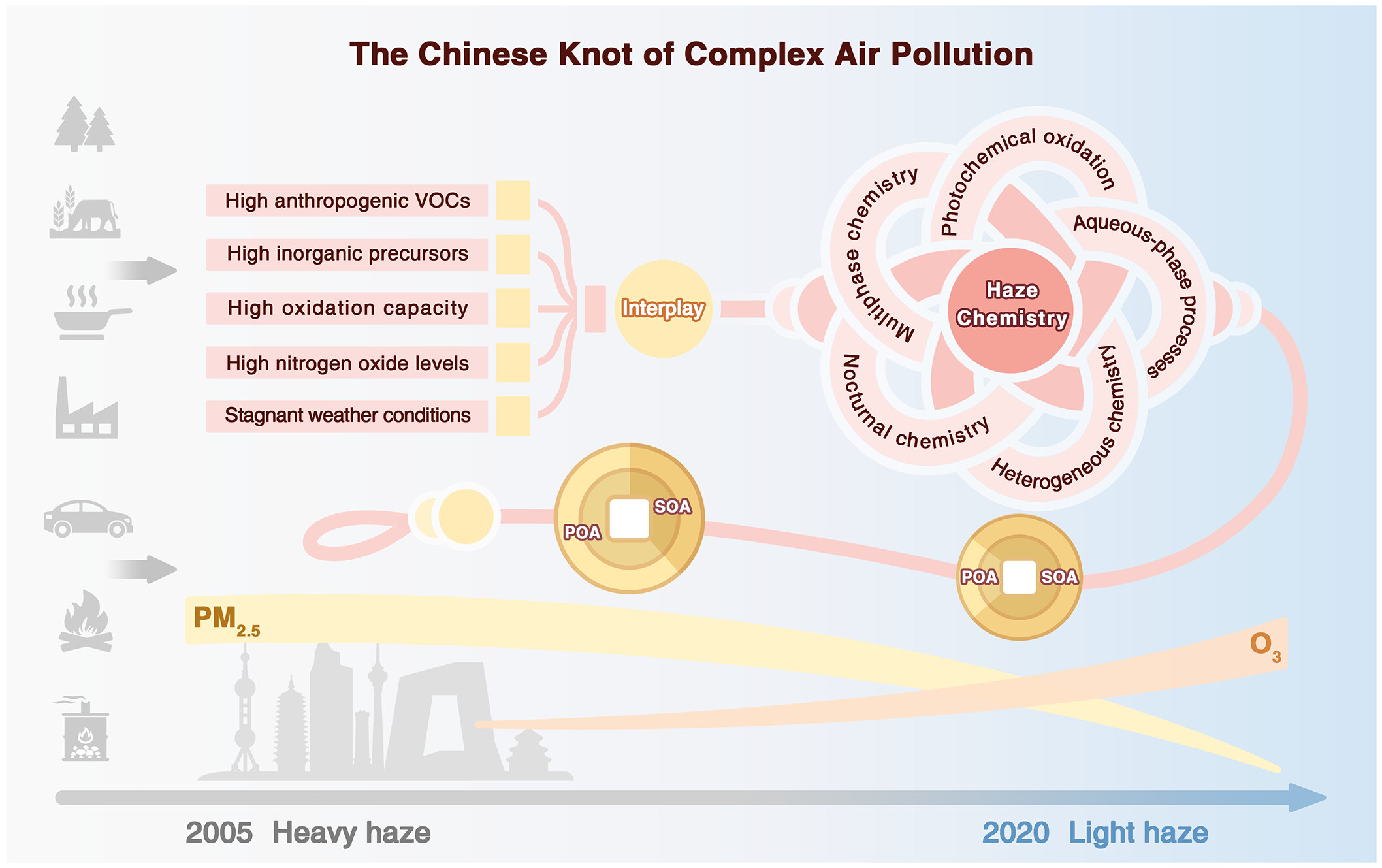
Urban air pollution is a globally concerning environmental issue with profound impacts on atmospheric visibility, public health, and the climate system. Over the past four decades, China's rapid economic growth and continuous urbanization have led to severe air pollution problems. In particular, haze pollution events characterized by high concentrations of particulate matter are not only long-lasting and wide-ranging but also exhibit unique chemical environments and formation mechanisms. In terms of underlying mechanisms, haze pollution in China was initially dominated by primary particulate matter directly emitted from various pollution sources. With the deepening of air pollution control measures, primary particulate emissions have been effectively reduced, and secondary aerosols (especially secondary organic aerosols, SOA), formed through atmospheric chemical reactions from precursors such as nitrogen oxides (NOₓ) and volatile organic compounds (VOCs), have become the dominant contributor to haze pollution. There is an urgent need for systematic research on their formation mechanisms.
Professor Ru-Jin Huang from the Institute of Earth Environment, Chinese Academy of Sciences, and his colleagues published a Review article in Science entitled "Secondary organic aerosol in urban China: A distinct chemical regime for air pollution studies." This study, conducted in collaboration with international scientists from Aarhus University (Denmark), the University of Macau, Peking University, the Guangzhou Institute of Geochemistry (Chinese Academy of Sciences), King Abdullah University of Science and Technology, the Hong Kong University of Science and Technology, the University of Colorado Boulder, the Institute of Chemistry (Chinese Academy of Sciences), Tsinghua University, the University of Helsinki (Finland), the University of Groningen (Netherlands), the University of California Irvine, Johannes Gutenberg University Mainz (Germany), Columbia University, and other institutions, revealed through comparative analysis with historical air pollution events in Europe and the United States that the complex interactions among multiple atmospheric environmental factors in China collectively contribute to the unique formation mechanisms of secondary organic aerosols in urban atmospheres. The article systematically elaborates on several key contributing factors: (i) Unlike in Europe and the United States, where biogenic VOCs are dominant, anthropogenic emissions from industrial sources, residential combustion, solvent use, and other sources in China release a greater variety and higher concentrations of VOCs; (ii) The concentration of gaseous nitrous acid (HONO) in Chinese urban atmospheres is an order of magnitude higher than that in Europe and the United States, and its photolysis generates large amounts of hydroxyl radicals (OH), significantly enhancing atmospheric oxidizing capacity during winter; (iii) High concentrations of NOₓ promote the formation of nitrogen-containing organic compounds, particularly peroxyacyl nitrates (PANs), which prolong the lifetime of organic peroxy radicals (RO₂) and thereby exacerbate regional secondary pollution; (iv) Interactions between inorganic and organic pollutants and multiphase processes, especially the increase in aerosol liquid water content driven by the rising nitrate fraction, further facilitate the formation of aqueous-phase secondary organic aerosols. The article also discusses the implications of anthropogenic SOA formation and aging processes on particle hygroscopicity, optical properties, and health effects. It further outlines future research priorities, with particular emphasis on the need to explore unknown oxidation pathways, achieve molecular-level characterization of precursors and multi-generation oxidation products, and conduct in-depth investigations into the corresponding formation and aging mechanisms.