
W. Xu, J. Ovadnevaite, K. N. Fossum, C. S. Lin, R. J. Huang*, D. Ceburnis, and C. O'Dowd (2022), Sea spray as an obscured source for marine cloud nuclei, Nature Geoscience, 15(4), 282-+, doi:10.1038/s41561-022-00917-2.
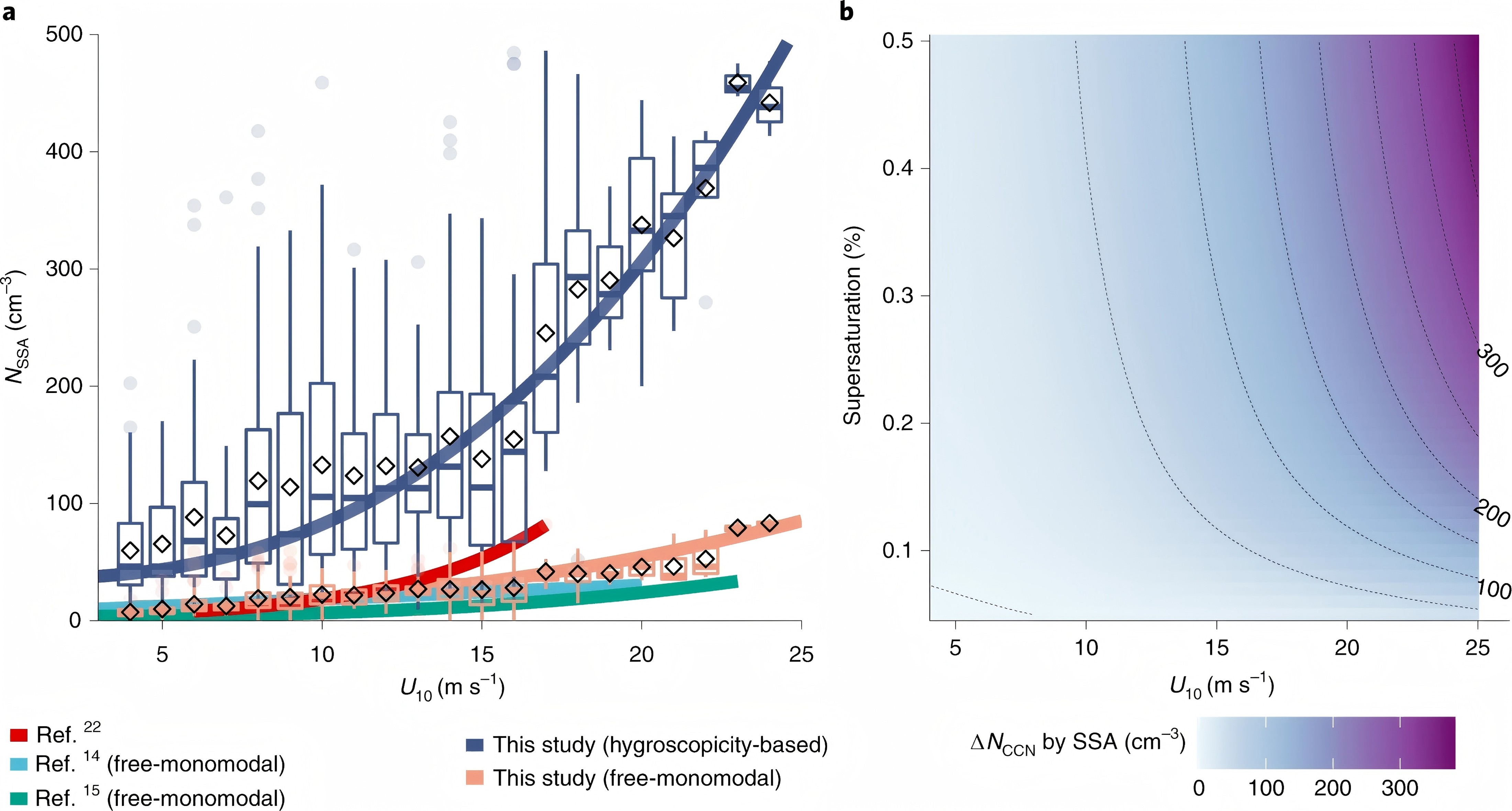
Sea spray aerosols (SSAs) make up a substantial proportion of aerosols in the global atmosphere and, especially when considering marine haze and cloud layers, can have a large impact on cloud formation and atmospheric radiative balance. Although SSA has the highest cloud condensation nuclei (CCN) activation potential, the majority of its population, residing in sub-micrometre sizes, are often obscured by non-sea-spray CCN. Quantification of SSA-derived CCN is fundamental in understanding the radiative budget. Recent approaches to estimate the sub-micrometre SSA employed a free-monomodal lognormal analysis that depicts the global oceanic CCN population comprising less than 30% SSA. Here we derive SSA distributions from a unique five-year dataset of aerosol microphysics and hygroscopicity (water uptake ability) over Atlantic waters. This approach utilizes the distinctive ultra-high hygroscopicity signature of inorganic sea salt and is able to identify the sub-micrometre sea spray down to 35 nm diameter with high time and size resolution. In stark contrast to previous studies, the hygroscopicity coupled multimodal fitting analysis yields SSA-derived CCN as much as 500% in excess of estimates produced using the free-monomodal approach. Our results suggest the contribution of SSA to global CCN, particularly Aitken mode SSA, has probably been overlooked.